Content Planning
Content Planning is where you decide what your marketing is about, before any single post or email gets written. It has three connected tools. Content Pillars are the handful of evergreen themes that anchor everything the agents produce. The Content Queue is the running list of specific ideas moving from a raw thought toward a finished piece. Content Networks take one pillar topic and turn it into a coordinated set of pieces that publish in order. Set the pillars first, feed the queue, and the rest of the marketing work lines up behind them.
Pillars sit upstream of every marketing agent. When the Marketing Strategist plans a campaign, when a writer drafts a post, when the visibility work picks what to track, they all read your pillars first. Get the pillars right and everything the agents make stays on theme.
What You See
The three tools are separate screens, each built around the same simple shape: a band of numbers up top, then the lists you act on.
Content Pillars has two sections. The top one is your pillars: each is a short, named theme with an optional line describing what it covers. The lower one is recurring themes, which are beats that come back on a set cadence (monthly trends, a quarterly review, year-end planning). A small band at the top counts how many active pillars and recurring themes you have. Retired pillars and themes are hidden until you choose to show them. Open a pillar's rollup and you see what it is actually producing: the queue topics linked to it and the visibility prompts that track it, so you can tell at a glance whether a theme is pulling its weight.
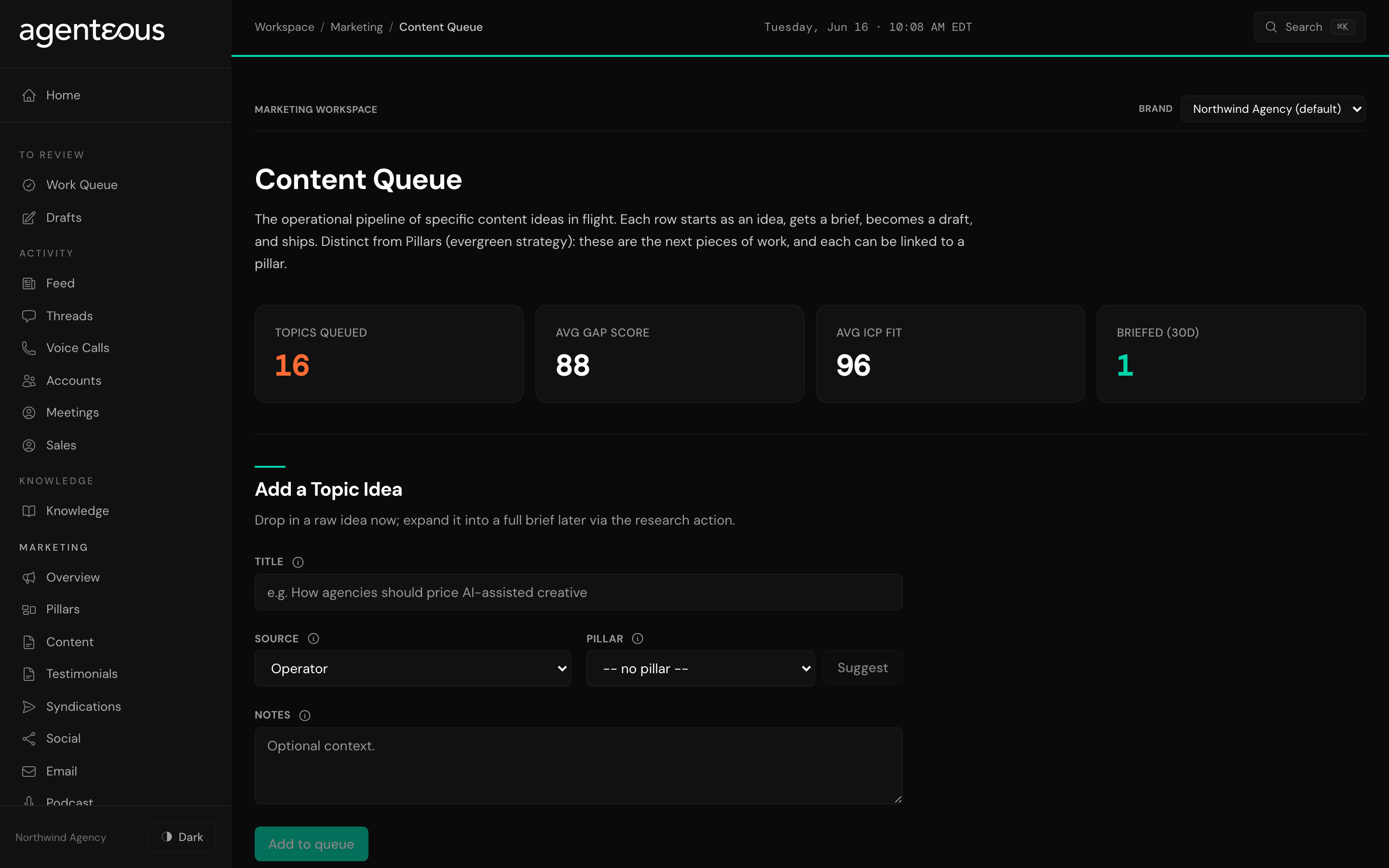
The Content Queue is a feed of specific content ideas, newest first. Each row carries a title, where the idea came from (a gap in how the brand shows up in AI assistants, a competitor, a real question from your clients, or your own team's instinct), how recent it is, and two read-outs: a gap score for how much of an opening the topic represents, and an ICP fit for how cleanly it matches the brand. Numbers up top tell you how many ideas are queued, the queue's average scores, and how many ideas have been turned into briefs lately. A status on each row shows where the idea stands: a raw idea, researched, briefed, written, or published.
Content Networks is a grid of coordinated pushes. Each card names the topic, shows its status, and tracks progress as a count of finished pieces against the total planned. Open one to see the pieces it contains, grouped into waves that publish in order.
What You Can Do
On Content Pillars, you shape the themes that drive the agents:
- Add a pillar. Give it a name and, if you like, a short line on what it covers. From that point on, the marketing agents treat it as a theme worth writing about.
- Edit a pillar. Rename it or refine its description as your focus shifts.
- Retire and restore. Retire a pillar that no longer fits without losing its history; show retired items and restore one if you want it back.
- Add recurring themes the same way, with a cadence noting how often each comes around.
- View a rollup on any pillar to see its linked queue topics and visibility prompts in one place.
On the Content Queue, you move ideas from thought to shipped:
- Add a topic. Type a short, specific title, pick where the idea came from, optionally attach a pillar, and drop in any notes for the writer.
- Link it to a pillar so the idea rolls up to the right theme. You can ask the strategist to suggest the best fit, then keep or change it.
- Research it. One action expands a raw idea into a full brief: a target keyword, the searcher's intent, the key questions to answer, and the gap and fit scores. This takes a few seconds.
- Move it along. Mark a topic as researched, briefed, written, or published as the team works it, so the queue always reflects reality.
- Filter by status or source to focus on, say, only the ideas still waiting for a brief.
On Content Networks, you turn one theme into a coordinated push. Plan a network from a pillar topic, give it a topic line, and the agents lay out a set of pieces in dependency order: a cornerstone piece first, then the supporting pieces that build on it and cross-link back. Each network tracks its own progress, and you open the pieces from the queue as they come up.
How It Connects
These three tools feed the rest of your marketing. Pillars are the spine: the Marketing Strategist and every writing agent read them before they draft, so a clear set of pillars keeps all the agents pointed the same way. The Content Queue is where strategy becomes specific work; a researched topic becomes a brief, and that brief is what a writer in The Marketing Workspace picks up. The questions you track in AI Visibility link to pillars too, so a theme's strategy, its content ideas, and how it shows up in AI assistants all roll up together. A Content Network is the most ambitious move: it takes a single pillar topic and turns it into a planned campaign of pieces, each landing in the queue when its turn comes.
Start with the pillars. A short, focused list of themes (a handful, not dozens) gives the agents a clear brief and keeps your queue from drifting. When an idea no longer fits any pillar, that is a signal to either reshape your pillars or let the idea go.